When I bought Live Magic (Vic back then!) she had some plastic to allow the hatch to slide open and closed. I think this was at some stage the plastic rubbing strip found on some dinghies but had long since suffered at the hands of the elements. This plastic was wavy for want of a better word, and the hatch would jump up and down as it was opened and closed with the most awful screeching noises. Fast forward a few years while I ignored the situation and I plonked a dinghy on the coachroof following a trip to the pub. The plastic snapped. Bugger. So, on to the fix or so you'd imagine. Not quite. Plastic comes in various shapes, sizes and types. I looked high and low for something appropriate to no avail. My dad then surprised me by coming up with some UPVC window strip which was a perfect fit (mine being 40mm x 5mm thanks to various wear and tear). This was THE answer clearly. It was the right size, the right shape, and £3 a strip. Dad only had just over a metre though, so off we went to B&Q who had 45mmx5mm or 40mm x 7mm both of which would require filing a larger hole on the hatch, and I hate removing bits of the boat permanently. So, long story short I cut the bit my dad had in half and suffered with half sliders for a while. A long while. Nearly a year. This was fine, except that every time I opened the hatch it would scrape on the roof, and every time I closed it, I'd have to line up with the shorter sliders to lock it. This was tiresome, but my laziness knew no bounds. Someone else mentioned stainless sliders on a forum or Facebook a while back so while bored I googled stainless bar on a whim and it was cheap. Really cheap, why had I held out for plastic?!
So I bought some. The sliders needed to be 1120mm length and the flat bar in 40mm x 5mm was available in 250mm increments so I bought two 1250mm lengths plus a 250mm length for testing. This is important in all your boating DIY endeavours, ALWAYS buy an extra bit for testing!
So, upon arrival, I measured a second time on the boat and marked up length and width with a sharpie (permanent marker). Width of the runner was obviously 40mm but width of what I would screw into wasn't, and on the Vivacity goes from about an inch to about 2/3 inch over the length in question so the holes would need to line up. As you'll see later the holes had to be pre-drilled (another vote for plastic!!). I then cut them to length with a hacksaw. This took AGES. 316 Stainless bar hates tools and saps energy. Maybe I'm just weak but I like to think I can cut a bit of metal without trouble!
So next step was some holes. How far apart? Well here I happened to have some (wrong sized) UPVC strip to hand due to an earlier error. Realistically, for about £3 it was worth it just for this testing. As you can see in the pic I tried a hole pattern to see how it looked. I tried two in fact, and the closer spacing won, with 6 holes in total. Some quick match led to spacing evenly with a nice gap at the end, all spacing done for aesthetics really since this bar is going nowhere with 5, 6 or 7 screws.
So...drilling...did I mention that 316 stainless hates tools? I Googled and found I needed HSS drill bits. A friend later told me cobalt works better, and he knows what he's doing. He also said go slow and use a cutting compound which seems like sage advice. I used the other advice plastered all over the Internet. This advice goes thusly...stainless will work harden when you do anything so be sure to make a cut first time and keep going. This advice works but anyone with empathy for their tools will weep. The first hole was smoking, literally. Hot as hell but made it through with a reasonably neat hole. I'm pretty sure this is not the optimum method but I managed 12 good holes. The HSS countersink seemed particularly pissed off with me, and performed exactly the manoeuvre the Internet foretold with a very bumpy ride. Anyway, it all worked and the therapy has allowed me to forget what I did to the bits and the drill.
Speaking of drill, you will literally kill yourself with a hand held drill, so I once again brought out the pillar drill (you may remember the pillar drill from my teak project with plugs). This is important. Use a guide, you'll see my homemade guide in the pics which is a bit of wood bolted tight to allow me to slide the bar along and keep holes in the same place. This means I could position accurately without effort and also that I could revisit every hold accurately with the countersink since they were all the same distance from the side of the bar.
Safety safety safety with this stuff. Wear gloves for the heat, I touched the drill bit at one point to see if it was hot. It was. Wear goggles for the flying shrapnel since they cost £2 and your eyes are priceless. Wear a dust mast because the stuff in stainless is evil and will destroy your lungs. Maybe not drilling but sanding without doubt.
This pic shows the drilled and countersunk holes. Notice how dull the bar is, this needed fixing. I went and bought a bench grinder and metal polishing kit online to shine it up a bit. Sadly I underestimated the metal again and the surface pitting from manufacture was quite deep and could not be polished. When I finally (after many hours of using wet and dry paper) realised that metal is just REALLY hard shiny wood, I tried some 120 grit paper and started to make progress. Painful progress but progress nonetheless. I bought a belt sander to speed things up, since this is basically a linisher without the fancy stand, safety, built for purpose type features. This was amazingly better. Belt sanders will destroy anything in a hurry and so obviously I had to be careful. I used the 80 grit to start and get the pits out. Clamp your bar down to allow you to forget about projectile weapons and work on sanding. I moved up from 80 grit to 100 then back to manual sanding with 240, 400 then 600. This was all 2 days into the project so frankly I'd lost interest in a mirror shine by now and spent too little time finishing off. As luck would have it, I actually realised the folly of mirrored surfaces on the coachroof in summer. Not ideal to suddenly see the full fury of the Sun while tacking!
So what you see is a compromise between laziness, effort, results, and being able to see on a sunny day. It's quite shiny but not completely reflective. The steel fits well, and will likely never break. It is, however, really REALLY hard to work with. It's also cold and uncomfortable to lean on compared to plastic and adds weight to a boat which could probably do with dropping a few pounds. Overall I'm happy with the results, but this is one of the hardest projects I've done and I hope to not need stainless again for a while as it's harder than rocks!
Welcome to my blog about Live Magic, a Vivacity 20 yacht based on the south coast of England. Here I will update on trips, maintenance and any projects being undertaken.
Sunday, 5 April 2015
Monday, 30 March 2015
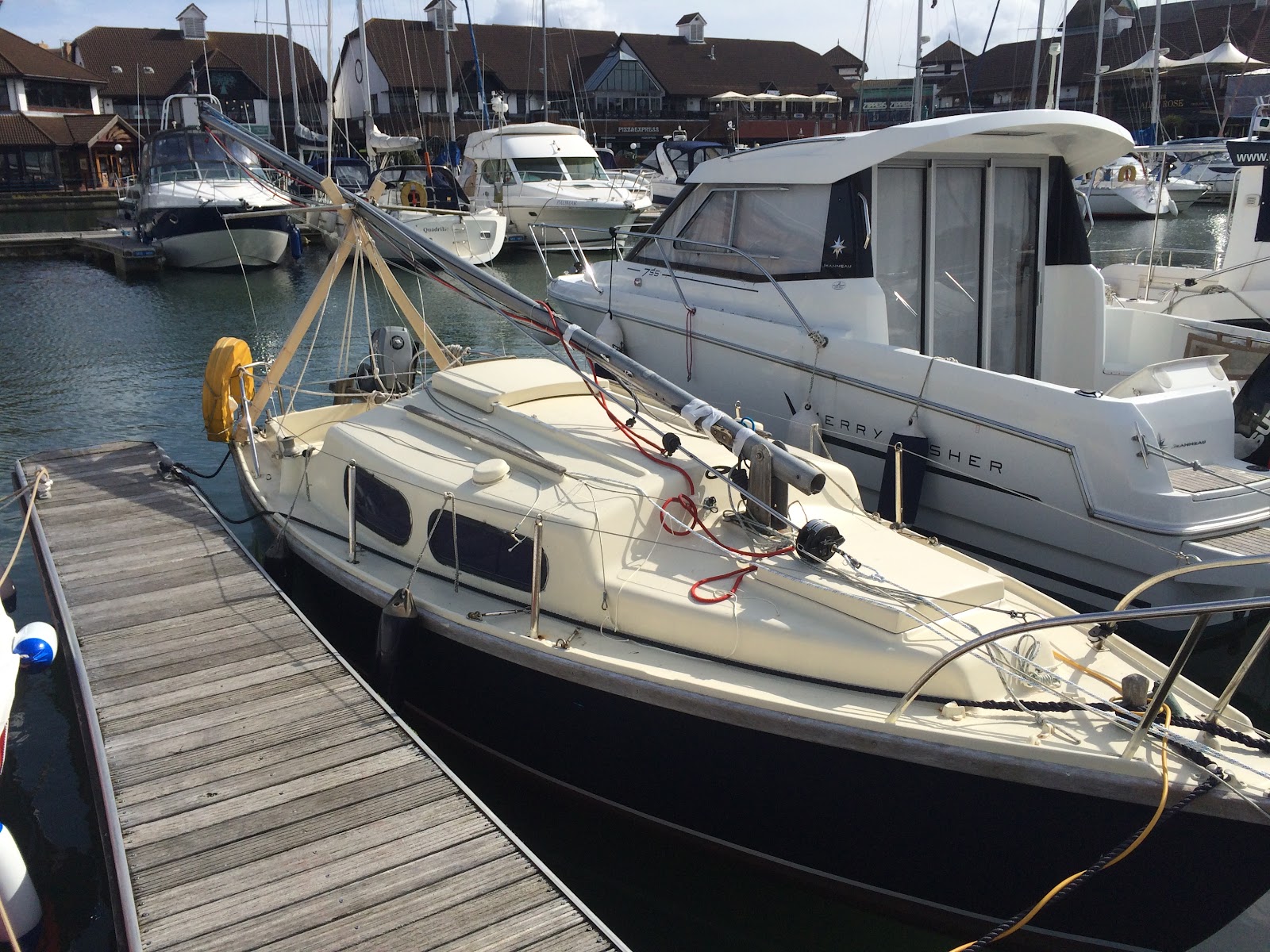
Using the tabernacle
Having had the boat a few years now, I've taken the mast down and put it back up a fair few times. Firstly to install the roller reefing, then various maintenance tasks such as adding tape to the spreaders to stop (another) rip in the cruising chute. Most of the time I do this by myself these days having developed a bit of a technique over the years so I thought I'd share this "wisdom" with you, the Internet. This is probably not the best way of removing a mast in a tabernacle, but it works for me.
Step one is preparation. This is really, really important as surprises half way through are not fun at all (trust me!). At the stern, I rig a cross to hold the mast. This is little more than two pieces of cheap pine with a big bolt through them. As you can see, these are held in place with various ropes. One to the back of the tiller, which also ties to the traveller bar. This gives fore/aft stability to the wood. Next there is a rope from the top to the cleat on the port and starboard side deck which also then go on to tie the base of the wood to the pushpit in order to stop the bottom sliding about. This hold it fairly strongly in place ready for the mast.
As you'll also see in the picture above, I have taped everything up to the mast. Start this off by undoing the cables for lights and aerial and tape these to the stern side of the mast. A tabernacle makes an excellent scissor and will cut the cables if they are in any way loose. Luckily I found this out as I dropped the mast to replace the cables!
Next, remove the boom completely and bring forward the various lines tied to it. The sheet will come off and stay at the stern, the vang will sit on the coachroof, and the topping lift and lazy jacks come to the mast along with the halyard which will need removing from the main. Tape these to the mast with as little play as you can so that you don't later have ropes all over the place. I used to use electrical tape for this but duck tape (AKA gaffer tape) is much easier and neater as well as being easier to remove later by ripping it. Once you're happy with the ropes, it's on to the rigging.
Loosen all of the rigging screws, making sure to relax the tension all around before fully unscrewing. Although not necessary to loosen gradually first I think it puts less stress on the mast so I prefer to do it this way. Once these are all loose, I also loosen the bolts in the tabernacle. Remember that the top one will stay in while the mast lowers, but needs to be loose to allow movement The bottom one at this point can be loosened almost to the point of nut removal so that just before dropping the mast this is very quick to remove - you'll want to move calmly but quickly at that point so have everything ready.
This is my latest technique. I tie a piece of cord to each rigging wire with a bowline. This then goes through the deck eye and back three times to give me some leverage. I can then tighten it and tie off with some half hitches to stop the rig moving while keeping it ready to drop. This is also much quicker to do after raising than going straight to the screws, and you can pretension the wires before connecting the screws.
Finally, I remove the clevis pin from the forestay under the roller reefing. Here, I tie a rope to the bottom of the roller reefing which is led through the anchor roller and up to the coachroof. I use this rope to gently lower the mast until it's far enough down for me to just hold it. I then remove the cords from all rigging wires and the mast is essentially free standing. It can be helpful to tape the wires to the mast at this point to stop them going in the water if you're doing this on your pontoon/mooring (if you are, bear in mind that side to side movement can cause damage once the mast is free). The lower bolt in the tabernacle is next after putting tension on the rope to the forestay. The design of the tabernacle means you can lean the mast forward and it rests in place, so lean into it while removing the bolt so that it doesn't fall on you. Gently let the rope out and allow the mast to drop, standing near the (closed) hatch while it drops into your waiting arms. The further back you are the better your mechanical advantage for holding it up so don't be too close to the mast foot when doing this. You do, however, need to be on the coach roof since the rope won't be sufficient to hold the mast past a certain angle. Many use a pole in front of the mast to add leverage here but for me it's more effort than it's worth. Once the mast is in your hands, gently lower it to the wooden cross. This needs to be tall enough that you can easily lower into it from the roof as you don't want to be stepping down from the roof while holding the mast - trust me!
Tape the roller reefing to the front edge of the mast at this point to prevent damage to it, they bend easily and worse, get in the way while moving the mast. At this point you can remove the top tabernacle bolt.
Now it's just tidying up to do. Pick the mast up and slide it forward. You'll want to be near the middle of the mast for this part so it balances unless you have help. The base of the mast can slide through below the pulpit and stay sitting on the wooden cross.
Raising is simply the opposite to lowering :)
Step one is preparation. This is really, really important as surprises half way through are not fun at all (trust me!). At the stern, I rig a cross to hold the mast. This is little more than two pieces of cheap pine with a big bolt through them. As you can see, these are held in place with various ropes. One to the back of the tiller, which also ties to the traveller bar. This gives fore/aft stability to the wood. Next there is a rope from the top to the cleat on the port and starboard side deck which also then go on to tie the base of the wood to the pushpit in order to stop the bottom sliding about. This hold it fairly strongly in place ready for the mast.
As you'll also see in the picture above, I have taped everything up to the mast. Start this off by undoing the cables for lights and aerial and tape these to the stern side of the mast. A tabernacle makes an excellent scissor and will cut the cables if they are in any way loose. Luckily I found this out as I dropped the mast to replace the cables!
Next, remove the boom completely and bring forward the various lines tied to it. The sheet will come off and stay at the stern, the vang will sit on the coachroof, and the topping lift and lazy jacks come to the mast along with the halyard which will need removing from the main. Tape these to the mast with as little play as you can so that you don't later have ropes all over the place. I used to use electrical tape for this but duck tape (AKA gaffer tape) is much easier and neater as well as being easier to remove later by ripping it. Once you're happy with the ropes, it's on to the rigging.
Loosen all of the rigging screws, making sure to relax the tension all around before fully unscrewing. Although not necessary to loosen gradually first I think it puts less stress on the mast so I prefer to do it this way. Once these are all loose, I also loosen the bolts in the tabernacle. Remember that the top one will stay in while the mast lowers, but needs to be loose to allow movement The bottom one at this point can be loosened almost to the point of nut removal so that just before dropping the mast this is very quick to remove - you'll want to move calmly but quickly at that point so have everything ready.
This is my latest technique. I tie a piece of cord to each rigging wire with a bowline. This then goes through the deck eye and back three times to give me some leverage. I can then tighten it and tie off with some half hitches to stop the rig moving while keeping it ready to drop. This is also much quicker to do after raising than going straight to the screws, and you can pretension the wires before connecting the screws.
Finally, I remove the clevis pin from the forestay under the roller reefing. Here, I tie a rope to the bottom of the roller reefing which is led through the anchor roller and up to the coachroof. I use this rope to gently lower the mast until it's far enough down for me to just hold it. I then remove the cords from all rigging wires and the mast is essentially free standing. It can be helpful to tape the wires to the mast at this point to stop them going in the water if you're doing this on your pontoon/mooring (if you are, bear in mind that side to side movement can cause damage once the mast is free). The lower bolt in the tabernacle is next after putting tension on the rope to the forestay. The design of the tabernacle means you can lean the mast forward and it rests in place, so lean into it while removing the bolt so that it doesn't fall on you. Gently let the rope out and allow the mast to drop, standing near the (closed) hatch while it drops into your waiting arms. The further back you are the better your mechanical advantage for holding it up so don't be too close to the mast foot when doing this. You do, however, need to be on the coach roof since the rope won't be sufficient to hold the mast past a certain angle. Many use a pole in front of the mast to add leverage here but for me it's more effort than it's worth. Once the mast is in your hands, gently lower it to the wooden cross. This needs to be tall enough that you can easily lower into it from the roof as you don't want to be stepping down from the roof while holding the mast - trust me!
Tape the roller reefing to the front edge of the mast at this point to prevent damage to it, they bend easily and worse, get in the way while moving the mast. At this point you can remove the top tabernacle bolt.
Now it's just tidying up to do. Pick the mast up and slide it forward. You'll want to be near the middle of the mast for this part so it balances unless you have help. The base of the mast can slide through below the pulpit and stay sitting on the wooden cross.
Raising is simply the opposite to lowering :)
Parallel Pin Punch
I thought a little post on these might be a good idea since I suspect most people are unaware of them. When working on rigging, there is occasionally a pin which holds something in. On Live Magic, this is the case at the mast head where there are pins of around 5mm diameter holding blocks in place as well as to connect the standing rigging. By design, these pins are a tight fit, and although they do use split pins at either end to ensure they won't fall out they are extremely hard to remove. A hammer can be used to bash it up to a point, but then you need something small enough to go through the hole and keep pushing. Obviously, you could use a screwdriver or centre punch, but these will damage the pin and potentially spread the metal outwards, making it too large for the hole and therefore also even harder to remove. Enter the parallel pin punch, basically a round piece of metal with a flat end which is designed to push pins out of holes. They are really cheap too, so no excuses to not use them.
Tuesday, 20 May 2014
Beaulieu River
As well as woodwork, last weekend I took Live Magic to Beaulieu River for the first time. A friend and I had discussed this earlier in the year and never made it, and neither of us had been before. Alan was also somewhat new to anchoring - something we all suffer from in the Solent due to the relatively few anchorages and many marinas and moorings available. So, in the pub on the Friday night following a very warm day and with more forecast for the weekend we decided the time had come. The following morning I checked the tides to find that we didn't need to leave until 11am. This is new to me, having berthed in Emsworth behind the cill for three years I'm now able to leave any time I like and plan around tidal streams. It turned out that we left at 11:30 and slowly made our way down Portsmouth Harbour - I sailed most of the way but with a southerly wind ended up motoring the last bit which is also a requirement when leaving Portsmouth Harbour anyway.

Once out into the Solent we sailed west and caught a storming tide. I had 1kt through the water and 4.5 over the ground most of the time.

Since the wind was behind me, and due to speed and direction was very light indeed, I cooked dinner while sailing towards Beaulieu. I'm kind of lucky in that I can just take my cooker on deck and cut veg and stir the pot while also sailing if it's calm. Unfortunately this means when it's rough I have no gimbals and no hot food but it's a fair trade off.


Once we arrived in the river we were expecting chaos. It was the best weekend of the year so far and all reports say that this river is packed all the time. As it turns out, the anchorage was virtually empty, with only a single other yacht when we arrived. Once we had anchored, I inflated my dinghy and Alan launched his. We didn't need two, but I don't get to use mine very often and he was testing a new to him engine. We motored against the current for a while in some of the most beautiful surroundings I've seen on any boating trip - this is what boating is all about! We met with the harbour master who gladly took out £5.50 anchoring fee each in exchange for some knowledge of the river. On we went to tie up at Bucklers Hard and a quick pint in the Master Builders pub. This dinghy journey had been around an hour including a refuel stop (not planned :o/ ) on the way so we only had one pint in the lovely beer garden. In future I may skip the Spag Bol in favour of their barbecue burgers which looked great, but on this occasion we were both very tired so sped back to the boats in the dinghies this time with a little tide, and steering with body weight (a far more exciting way to steer the boat!).

Once back on board, I reheated the bolognese and cooked spaghetti (only realising at the last moment I have no colander on board). While cooking I poured a glass of cold Marlborough white wine and deflated the dinghy and put the engine away.

After dinner Alan and I chatted between boats on deck for a while until sunset while listening to the twitter of the birds on the Island and the gentle lapping of water against mud on the bank.

The following morning I awoke to paradise - another sunny day and still water.

I cooked bacon and made tea then did the washing up before we headed for home. With the wind from the south east against the east going tide it was a little rough on the way home but a fun sail nonetheless. Finally got back early afternoon and washed the boat down before heading home for a rest.

Once out into the Solent we sailed west and caught a storming tide. I had 1kt through the water and 4.5 over the ground most of the time.
Since the wind was behind me, and due to speed and direction was very light indeed, I cooked dinner while sailing towards Beaulieu. I'm kind of lucky in that I can just take my cooker on deck and cut veg and stir the pot while also sailing if it's calm. Unfortunately this means when it's rough I have no gimbals and no hot food but it's a fair trade off.
Once we arrived in the river we were expecting chaos. It was the best weekend of the year so far and all reports say that this river is packed all the time. As it turns out, the anchorage was virtually empty, with only a single other yacht when we arrived. Once we had anchored, I inflated my dinghy and Alan launched his. We didn't need two, but I don't get to use mine very often and he was testing a new to him engine. We motored against the current for a while in some of the most beautiful surroundings I've seen on any boating trip - this is what boating is all about! We met with the harbour master who gladly took out £5.50 anchoring fee each in exchange for some knowledge of the river. On we went to tie up at Bucklers Hard and a quick pint in the Master Builders pub. This dinghy journey had been around an hour including a refuel stop (not planned :o/ ) on the way so we only had one pint in the lovely beer garden. In future I may skip the Spag Bol in favour of their barbecue burgers which looked great, but on this occasion we were both very tired so sped back to the boats in the dinghies this time with a little tide, and steering with body weight (a far more exciting way to steer the boat!).
Once back on board, I reheated the bolognese and cooked spaghetti (only realising at the last moment I have no colander on board). While cooking I poured a glass of cold Marlborough white wine and deflated the dinghy and put the engine away.

After dinner Alan and I chatted between boats on deck for a while until sunset while listening to the twitter of the birds on the Island and the gentle lapping of water against mud on the bank.
The following morning I awoke to paradise - another sunny day and still water.
I cooked bacon and made tea then did the washing up before we headed for home. With the wind from the south east against the east going tide it was a little rough on the way home but a fun sail nonetheless. Finally got back early afternoon and washed the boat down before heading home for a rest.
Monday, 19 May 2014
New Teak
Hi all, sorry it's been so long since I've posted any updates I've been very busy. I've just replaced the teak strips either side of the companionway as the old ones broke - never hold on to the sliding hatch for support at sea!
The new ones are also teak, which I sourced from Robbins Timber in Bristol, UK. This is sustainable teak and although more expensive than other hardwoods isn't as expensive as you'd imagine. I ordered a single length planed to size, the single length was to avoid a charge per piece for two separate pieces. Once it arrived, I cut my two lengths and had a little left over to use for plugs.
I then used a router to round the edges. To do this, I first rounded the top corners using the router end on to the wood to give the rounded end, then used the same bit to round the long edges and around the top. Finally I flipped over the wood and rounded the bottom edge as the Vivacity has a curve moulded in to the fibre glass between the step and where the wood attaches.
Next, I bought a plug and cutter set from Axminster tools. This includes bits for cutting plugs and matching holes which are used to cover the screws. I also bought a pillar drill to make sure I was cutting square on with these bits although it would be possible to carefully do without one.
Once the screws were in I glued the plugs in with wood glue. There is some argument about whether to use varnish, glue or nothing for this but I went with glue as I have no intention of removing these again while I own the boat.

A few hours later, I used a hacksaw blade to cut as close as possible to the wood. The tape is to avoid marking the wood too much.

Next I used a plane set really fine to plane off any remaining plug to flatten. It's possible here to just sand back but that would probably lead to a less flat surface even using a sanding block.

Finally I sanded back to smooth with a sanding block and 120 then 180 grit paper. Here you can clearly see the double rounded top edge.
The new ones are also teak, which I sourced from Robbins Timber in Bristol, UK. This is sustainable teak and although more expensive than other hardwoods isn't as expensive as you'd imagine. I ordered a single length planed to size, the single length was to avoid a charge per piece for two separate pieces. Once it arrived, I cut my two lengths and had a little left over to use for plugs.
I then used a router to round the edges. To do this, I first rounded the top corners using the router end on to the wood to give the rounded end, then used the same bit to round the long edges and around the top. Finally I flipped over the wood and rounded the bottom edge as the Vivacity has a curve moulded in to the fibre glass between the step and where the wood attaches.
Next, I bought a plug and cutter set from Axminster tools. This includes bits for cutting plugs and matching holes which are used to cover the screws. I also bought a pillar drill to make sure I was cutting square on with these bits although it would be possible to carefully do without one.
Once the screws were in I glued the plugs in with wood glue. There is some argument about whether to use varnish, glue or nothing for this but I went with glue as I have no intention of removing these again while I own the boat.

A few hours later, I used a hacksaw blade to cut as close as possible to the wood. The tape is to avoid marking the wood too much.

Next I used a plane set really fine to plane off any remaining plug to flatten. It's possible here to just sand back but that would probably lead to a less flat surface even using a sanding block.

Finally I sanded back to smooth with a sanding block and 120 then 180 grit paper. Here you can clearly see the double rounded top edge.
Tuesday, 10 September 2013
End of season?
I thought I ought to put up a little post since it's September to remind everyone that the "sailing season" is what you want it to be. I know one reader of this blog whose boat will literally be under a foot of ice shortly so he has an excuse but for everyone in Blighty take a look at the following pictures and ask yourself whether you really want to lay up soon, or if perhaps November is worth waiting for?
Sunday, 9 June 2013
Last week
Last week I sailed to the Isle of Man, and yesterday travelled 110NM from Peel to Scotland. None of this was on Magic, I'm only writing it here because someone on a forum used this blog as an example of my sailing experience, assuming that Magic was all I had sailed on and apparently 150 miles in a week in a Vivacity 20 makes me a poor sailor. With a bit of luck, said moron will realise that this blog is about the boat and not the sailor with this post and in future the blog can go back to just Magic related stuff :) The TT was awesome too by the way!
The run in to Peel (5 hours with the Spinnaker up, 10kt max TTW)
Loch Ryan, 5.30am
Sulby Straight, accellerating so hard the front wheel is up at 180mph
The Bungalow from the top of Snaefell
Tracks from the sailing
The run in to Peel (5 hours with the Spinnaker up, 10kt max TTW)
Loch Ryan, 5.30am
Sulby Straight, accellerating so hard the front wheel is up at 180mph
The Bungalow from the top of Snaefell
Friday, 3 May 2013
Yacht name (at last!)
Finally I took a photo of the name. The colours are a little washed out in this picture, both the name and the boat look much better in real life. I'm very pleased with the font and colour and more than a little relieved that the second name stuck! Thanks again to the forum member who made this.
Tuesday, 30 April 2013
Scuttlebutt Solent to Poole Cruise 2013
I'm a little too tired this evening to write up the trip, but here are the tracks from the last few days. Live Magic and I travelled over 100NM in 5 days with a top speed through the water of 6.4kt and a top speed over the ground of 10kt! We sailed through fog, ventured outside the Solent, and met some new friends from the forum.
Monday, 22 April 2013
What a weekend!
Well I hope all you folks out there in Internet land had as good of a weekend as me with your boats. I invited a friend along who, although we have sailed together many times, has never been aboard Live Magic. We slipped lines at Emsworth at around 8.30am on Saturday and left the marina with 6" of water under the keels. It's funny how you forget things like neaps over the winter, I think we actually could have gone out later but it still felt like a close shave. Adam took charge of the boat and I got the sails up almost straight away so by the time we passed the waiting pontoon in Emsworth we were under sail and the engine was silent with a nice easterly wind giving us a gentle beam reach all the way up the harbour. Once at the harbour mouth we sailed to Bar Beacon and turned for Cowes. I'll admit that because it was such a calm day we didn't actually get all the way to Bar Beacon, and had no intention of going near West Pole so started the turn early. On a run with the sails goosewinged we continued on toward the forts before crossing the shipping channel. We were nearly halfway across this when a ship steamed up and seemed determined to pass ahead of us, so we turned 90 degrees and sailed straight down the channel for a while with the ship passing us to port. A second ship could be seen at this point so we decided to wait for that to pass to port as well before resuming our crossing. Immediately after this we finished crossing to allow a third ship to pass to our starboard. After Ryde we turned in towards Cowes and on to a more sail friendly course until the wind died at Osbourne Bay. We started the motor for the remaining short hop to the Medina.
After passing Shrape we noticed several new buoys marking the new small boat channel into Cowes. These are considerably more straightforward than last year with both red and green buoys, and an extra set being added. We followed this channel and motored up the river to East Cowes Marina. Having called for a berth we were told to proceed to Quebec 18 but when we arrived it was taken. Q16 then, taken as well, then Q15 and finally P18 where we eventually tied up.
We then went on to have a couple of pints in various establishments on the island before having a decidedly disappointing meal in The Anchor. Hopefully they will improve again before the season but I Felt they we're now relying on the fact that they are close to the marina to get business where in the past the food had been good quality. Our "sizzling steaks" for instance were silent with raw onion beneath them on a warm cast iron plate.
The following morning, due to tides, we left at 4am and motored back on mirror calm seas and saw the most wonderful sunrise. The remainder of the day was spent sleeping :)
Monday, 1 April 2013
How I made the cockpit tent
Sorry this one took a while to write up, I've got no excuses as I was on holiday and doing very little! To make the cockpit tent I decided on a design first. I had several choices to make here, one was using GRP rods to give a rounded shape. I may still do this longer term but chose to go ahead without for now as it seemed roomy enough without, and stowing them would be a problem since they would either need ferrules or be 3m in length. I then made the decision to fit over the boom, using it as a support. This is not just easier but also practical. To fit under the boom I would have needed to sew in some kind of ties to attach it to the bottom of the boom which would almost certainly have introduced leaks, but also would have meant I would lose the boom inside as a wet locker for hanging oilskins on inside the tent.
Once the design was decided upon the rest was easy. I measured the boom from the end at the topping lift forward to the first lazy jack on the stackpack. Since this cannot be removed easily the tent has to go around it and therefore this is where a split needs to start.
Next,I measured forward from the lazy jack to the front of the open hatch below. I could easily have gone further and may make another in future which goes all the way to the mast but I decided this would make it even harder to get on or off the boat. You'll notice I have photos of the measurements, this is not because I took them for the blog but because it's a lot easier to do with a mobile phone camera than keeping bits of paper. This way I also have context for the measurements and can actually see where I measured to.
The tent ended up the shape in this picture. It's not to scale of course, but this shows the general idea. I got lucky that the fabric was 150cm wide so two widths fits perfectly. The dashed line in the middle is the join in the sheets, and this was the first job to give me a double width sheet to work with. I spent some time making sure this was a neat join and tucked the edges of the fabric in in both directions, this is harder than it sounds but is shown in the following side view picture. I used venture tape (double sided tape) to hold it together and sewed two lines where the red dashes are.
As you can see, this join stopped for the lazy jack where I separated the sides and sewed hems on, again doing a double fold and using venture tape.
The venture tape gets stuck along the edje of the fabric and then a cool iron (as hot as the fabric will take, not very hot at all for rip stop nylon) is used to set a nice crease. Finally, the venture tape is folded over and the backing removed to stick it down. Don't try to remove the backing beforehand or you'll end up in a mess. Remove it in sections by holding the fabric in place and pulling the backing out from under your hand so that you can guarantee that section is in the correct place.
Once the seam is stuck down, just run a line of sewing down it. I then did a second line to make it a little more durable and help keep the shape. When sewing with sticky tape you may need to clean both the needly and foot regularly to remove gunk which gets pulled through while sewing.
When all of the seams are in place, use some eyelets (hipkiss kits are ideal) to put the shockcord through for fastening. I used 5mm shockcord in black with 5mm black eyelets and black hooks as they contrast nicely with the bright white of the tent fabric. In all this project cost under £20 although I was still using up the venture tape from the stackpack project. Be sure to use UV resist thread, I found some polyester stuff in Fabricland which seems to fit the bill but time will tell.
Once the design was decided upon the rest was easy. I measured the boom from the end at the topping lift forward to the first lazy jack on the stackpack. Since this cannot be removed easily the tent has to go around it and therefore this is where a split needs to start.
Next,I measured forward from the lazy jack to the front of the open hatch below. I could easily have gone further and may make another in future which goes all the way to the mast but I decided this would make it even harder to get on or off the boat. You'll notice I have photos of the measurements, this is not because I took them for the blog but because it's a lot easier to do with a mobile phone camera than keeping bits of paper. This way I also have context for the measurements and can actually see where I measured to.
The tent ended up the shape in this picture. It's not to scale of course, but this shows the general idea. I got lucky that the fabric was 150cm wide so two widths fits perfectly. The dashed line in the middle is the join in the sheets, and this was the first job to give me a double width sheet to work with. I spent some time making sure this was a neat join and tucked the edges of the fabric in in both directions, this is harder than it sounds but is shown in the following side view picture. I used venture tape (double sided tape) to hold it together and sewed two lines where the red dashes are.
As you can see, this join stopped for the lazy jack where I separated the sides and sewed hems on, again doing a double fold and using venture tape.
The venture tape gets stuck along the edje of the fabric and then a cool iron (as hot as the fabric will take, not very hot at all for rip stop nylon) is used to set a nice crease. Finally, the venture tape is folded over and the backing removed to stick it down. Don't try to remove the backing beforehand or you'll end up in a mess. Remove it in sections by holding the fabric in place and pulling the backing out from under your hand so that you can guarantee that section is in the correct place.
Once the seam is stuck down, just run a line of sewing down it. I then did a second line to make it a little more durable and help keep the shape. When sewing with sticky tape you may need to clean both the needly and foot regularly to remove gunk which gets pulled through while sewing.
When all of the seams are in place, use some eyelets (hipkiss kits are ideal) to put the shockcord through for fastening. I used 5mm shockcord in black with 5mm black eyelets and black hooks as they contrast nicely with the bright white of the tent fabric. In all this project cost under £20 although I was still using up the venture tape from the stackpack project. Be sure to use UV resist thread, I found some polyester stuff in Fabricland which seems to fit the bill but time will tell.
Subscribe to:
Posts (Atom)